The Return of the Moka Pot
Do you remember that specific hissing sound and the aroma that would fill the entire house on Sunday mornings? Exactly – the return of the classic moka pots is a fact. In the era of capsule machines and super-automatic systems, the good old moka pot is once again finding its place on the countertop. This isn’t just nostalgia, but a conscious choice by people seeking authenticity and control over the process. Making coffee with it has a ritual, something that’s missing when you just press a button.
Moka pots nowadays
Modern moka pots are no longer just those old enameled pots. Today, they are both stylish and functional. They come in various sizes, colors, and materials, with stainless steel and aluminum being the most popular. But what actually is a moka pot? It’s a device that works on the principle of passing hot water under pressure through ground coffee. The resulting espresso is rich, aromatic, and has that characteristic crema layer we value so much.
Convenient, safe and simple
The resurgence of interest in these devices is also due to the fact that they are extremely durable and easy to maintain. They have no electronics that can break down, nor do they require special filters or capsules. You simply add water, put in coffee, and place it on the stove. It’s a purity and simplicity that is increasingly valued these days.
How moka pots work and why we like them
The operating principle is ingeniously simple, yet so effective. The bottom part is filled with water, which begins to boil. The pressure created by the steam pushes the water upwards through the filter containing the ground coffee. This way, the hot water extracts all the aromas and oils from the coffee as it passes through, collecting in the upper chamber. The whole process takes just a few minutes, and the result is unique.
The great thing about these devices is that they give you complete control. You decide what grind size to use, which blend to choose, and even how much water to pour.
-
They are extremely easy to clean – usually just rinsing them with water is enough.
-
They don’t take up much space and are portable – you can take them to the countryside or on a hike.
-
They work on any type of stove – gas, electric, or ceramic glass (depending on the model).
Their durability is also a big plus. A quality moka pot can serve you for decades without losing its qualities. It’s an investment in thousands of cups of aromatic coffee awaiting you every morning. No surprises, no software glitches – just you and your coffee.
The history of moka pots
The roots of this household favorite trace back to Italy in the early 20th century. In 1933, Alfonso Bialetti created the famous “Moka Express” model, which quickly changed the way Italians drank coffee at home. Until then, espresso was reserved exclusively for bars with their expensive and bulky machines. Bialetti’s idea was to make an octagonal moka pot that used the same principle, but in a smaller, more accessible version.
Over the following decades, the moka pot became a symbol of Italian life and lifestyle. After World War II, it began to be mass-exported throughout Europe and the world. Its design remained almost unchanged, proving that when something works perfectly, there’s no point in changing it. Every Italian household has at least one moka pot, often passed down from generation to generation.
During the 50s and 60s, the moka pot also became a design object. Manufacturers like Bialetti began experimenting with different materials and shapes. Despite the emergence of electric coffee makers and capsule systems in subsequent years, the classic model always found its buyers, and today it’s even experiencing a renaissance among young people discovering the charm of slow coffee.
Evolution of design over the years
If we look back, the first models were made entirely of aluminum, which is an excellent conductor of heat. Over the years, however, there has been a noticeable drive to improve materials and functionalities without losing the original concept.
-
Models made of stainless steel appear, suitable for induction hobs.
-
Manufacturers also began offering variants of different sizes – from a single cup to huge moka pots for 18 cups.
-
In the 21st century, interest returns to colorful enameled moka pots that brighten up the kitchen.
Despite these changes, the heart of the moka pot remains the same. The filter and pressure valve are refined to ensure even better extraction of aromas. It’s a wonderful example of how a good product can survive over time, simply by adapting slightly to new technologies without changing its soul.
The advantage of moka pots over coffee machines
When it comes to choosing between a moka pot and a coffee machine, many people wonder which to pick. Coffee machines are convenient, giving you coffee at the push of a button, but they are often expensive as an investment and in terms of maintenance. The moka pot, on the other hand, requires a bit more attention but offers things no coffee machine can give you. For example, complete control over the quality of the water and coffee.
One of the biggest advantages is the price. A quality moka pot costs about as much as a few boxes of capsules for a modern machine. Once you buy it, you only spend money on coffee beans, which works out significantly cheaper than capsules. Furthermore, the moka pot doesn’t use electricity when not in use, and it has no electronics that can fail after the warranty expires.
Last but not least is the feeling itself. Making coffee with a moka pot has a ritual that’s missing from automatic coffee machines. It’s like a little daily adventure – grinding the beans, pouring the water, the sense of anticipation as the coffee starts to appear from the top. It’s a moment for yourself that cannot be replaced by an automated process.
Environmental and economic considerations
Nowadays, more and more people are thinking about the waste they generate. Capsule coffee machines are a real problem for the environment if not recycled properly. The moka pot produces no waste apart from the grounds, which are biodegradable and can be used for fertilizing or exfoliating.
-
No need for paper filters – they are built-in and reusable.
-
You don’t use plastic or aluminum capsules.
-
Energy efficiency is significantly better – you only heat the amount of water you need.
From an economic standpoint, the difference is more than tangible. If you drink two coffees a day, the cost difference over a year between a moka pot and a capsule machine could buy you a new moka pot and some good coffee for several more months. It’s a choice that not only spares the environment but also spares your wallet.
Types of coffee suitable for a moka pot
Which coffee is best for this type of brewing? There are no strict rules here, but there are some guidelines that can help you get the most out of it. The most important thing is the grind. It should be slightly coarser than for an espresso machine, but finer than for a drip coffee filter. If you buy pre-ground coffee, look for a label saying “for moka pot” or “moka”.
Regarding varieties, you can experiment. Blends with Brazilian or Colombian beans yield a milder, chocolaty flavor. If you prefer stronger, more intense coffee, go for African varieties like Ethiopian or Kenyan, which have more pronounced acidity and floral notes. What’s important is that the coffee is freshly roasted, because that’s when the aromas are strongest.
Some people like to mix different types of coffee to get their own unique flavor. That’s one of the advantages of the moka pot – you are the master of taste. You can start with one base and add different beans until you find the perfect combination. Experiment and discover your favorite coffee.
Grind fineness and tamping
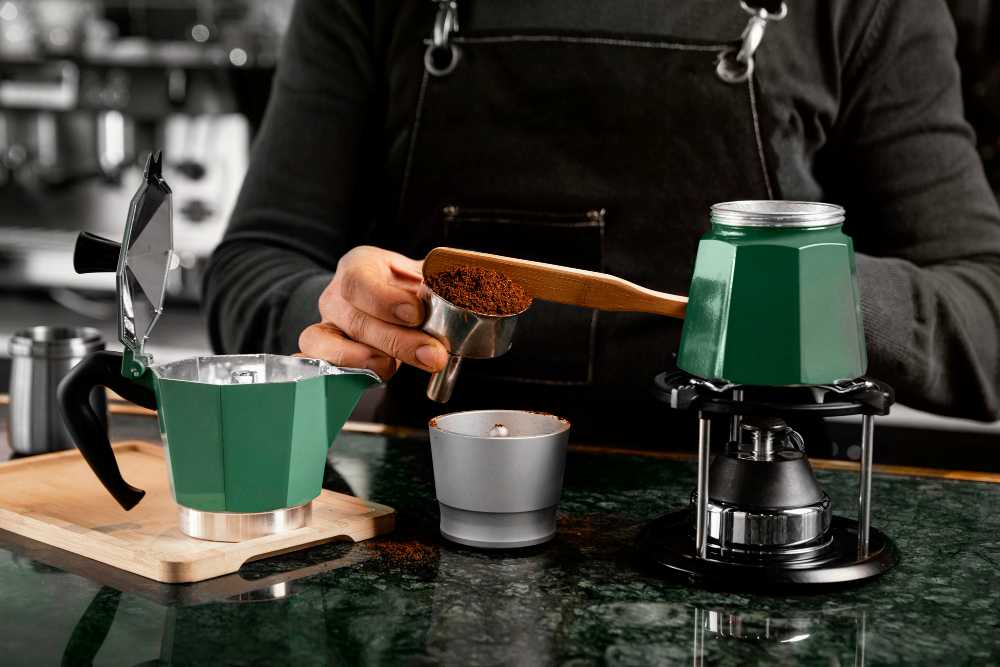
It’s important to know that the coffee should not be tamped down in the filter. Unlike professional espresso machines, no temper is required here. Simply pour the coffee into the basket, level it off with your finger or a spoon, without pressing it down. If you tamp it, the water won’t be able to pass through, and the coffee will turn out bitter or won’t come out at all.
-
For a lighter, more aromatic taste – use a coarser grind.
-
For a stronger, more intense taste – use a finer grind (but not like dust).
-
Never heap the coffee – the filter should be full, but not overpacked.
Experiment with different grind levels until you find the ideal balance. Sometimes even the coffee brand or its roast requires a small adjustment. This search is the fun part of the process and makes you a true coffee connoisseur.
Bialetti: quality from Italy
When we talk about moka pots, we simply cannot overlook the name Bialetti. This brand is synonymous with quality and tradition. Founded in 1919, the company quickly established itself as a leader in moka pot manufacturing. Their “Moka Express” model is perhaps the most recognizable design in the history of coffee – the octagonal shape and the little man with a mustache (the brand’s logo) are known worldwide.
Bialetti continues to manufacture in Italy, focusing on quality materials and precise workmanship. The aluminum they use is specially selected for this type of device, and the handles are made of bakelite, which doesn’t overheat. Their design is so good that dozens of manufacturers try to copy it, but they rarely achieve the same brewing quality.
The brand evolves and also offers modern stainless steel models, as well as electric versions. Nevertheless, the heart of Bialetti remains the classic stovetop moka pot. It’s proof that when you make something with care and passion, it can outlive its owner and bring joy to generations to come.
The legendary Moka Express model
This is the model that started it all. Its design isn’t just for looks – the octagonal shape has a practical function: it allows for easier opening and screwing, even when hands are wet or slippery from water. It’s a brilliant engineering solution that shows the creators’ mindset.
-
It’s available in different sizes – from 1 to 18 cups.
-
The classic aluminum model is suitable for gas and electric hobs.
-
It has a special pressure release valve that ensures safety.
This moka pot is more than a kitchen appliance – it’s a cultural phenomenon. In Italy, it’s found in every home, and worldwide it’s perceived as a symbol of the Italian lifestyle. If you’re looking for an authentic experience, Bialetti is the right choice.
Conclusion
The return of the moka pot is not accidental. It’s a result of our desire to slow down the pace and enjoy the little things. In a world of fast technology and artificial intelligence, some processes remain best when they are slow and hands-on. The moka pot gives you exactly that – time for yourself, control over quality, and a unique feeling of coziness. So, if you don’t have one yet, maybe it’s time to get one. Choose a quality moka pot, good coffee, and enjoy the moment. Believe me, you won’t regret it.
No matter what coffee you’re looking for and like, here you will discover a huge variety….
You read: The return of the moka pot
Category: Culinary
Latest posts
-
The return of the moka pot 14.02.2026
-

-
 February 2026 horoscope 12.01.2026
 -
 5 reasons to cook with an air fryer 08.01.2026
 -

Media Parthner


Categories
- Auto (6)
- Business (25)
- Cooking (8)
- Culture (4)
- Entertainment (12)
- Fashion (3)
- Health (7)
- Home and garden (8)
- Journeys (3)
- Mom and Dad (6)
- Motivation (1)
- Technologies (46)
- Trend (7)
- Zodiak (12)
- Без категория (1)